

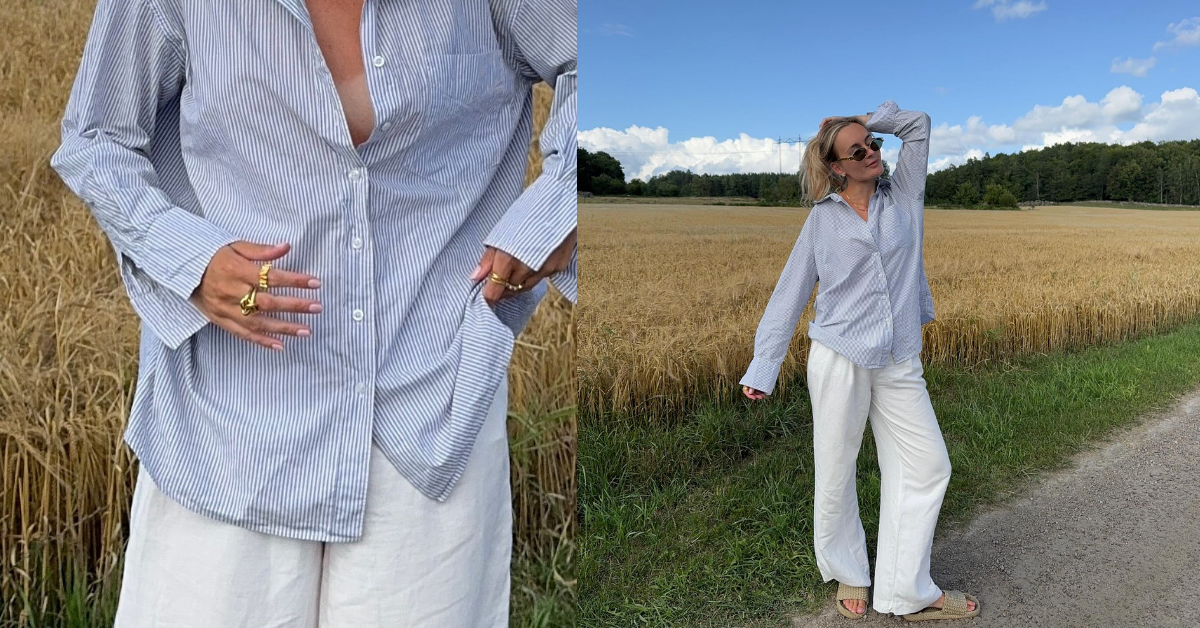
If you’ve ever looked at a Danish or broader Nordic outfit and thought, “Nothing here is crazy, so why does it look so good?”, the striped shirt is usually doing more work than you realize.
In Scandinavia, the striped top (often the Breton or marinière style) functions like a cheat code: it adds visual interest without adding “noise.” It reads classic, it layers cleanly, it plays well with denim, tailoring, and outerwear, and it gives your outfit a built-in point of view even when everything else is basic. That’s why stripes keep cycling back into street style, including Copenhagen Fashion Week coverage where stripes pop up again and again, from subtle tees to bold rugby styles.
What you’ll get here: why it works, how to pick the right stripe (so it doesn’t feel costume-y), and simple outfit formulas you can copy for real life.
Quick answer for skimmers
- A striped Breton style shirt is basically a “print-neutral”. It behaves like a solid because the colors are usually classic, but it adds texture-like interest.
- It looks “Scandi” because Nordic style rewards uniform dressing: repeatable basics, smart layers, and one quiet detail that signals taste.
- The OG marinière has roots in an 1858 French Navy uniform decree (that’s why it reads timeless).
- The easiest formula is stripe + denim + strong outerwear (coat, trench, blazer).
- Keep the rest of your outfit quiet: one pattern at a time unless you’re deliberately doing Scandi street-style mixing.
If you only do one thing: wear a navy-and-cream striped top with straight jeans and a structured coat. Add clean shoes. Stop there.
What people mean by “the Scandinavian striped shirt”
Most of the time, this is the Breton / marinière family: a boat neck or simple crew neck top with horizontal navy and white stripes. It became iconic after the French Navy officially codified the striped knit in 1858, and the regulations even got specific about stripe counts and spacing.
So why call it “Scandinavian” if it’s French? Because Scandinavians adopted it as a core wardrobe basic. It fits perfectly with Nordic dressing: functional, repeatable, and polished without looking like you tried too hard. And in recent coverage of Copenhagen Fashion Week street style and trends, stripes are consistently positioned as a Scandi staple that can be either minimal or playful.
Why it works in basically every outfit
1) It gives you contrast without chaos
Most Scandinavian outfits rely on calm color stories: neutrals, denim, black, navy, cream. Stripes give you built-in contrast (light/dark) while staying in that same palette. That makes the outfit look intentional, even if the pieces are simple.
2) It reads “classic” because it actually is
You don’t have to know the history for it to work, but the reason it never feels trendy-and-then-dated is that it’s tied to a real uniform origin (1858) and a long civilian fashion legacy.
3) It behaves like a neutral
A solid tee can look flat under a blazer. A loud print can feel like too much. A stripe sits in the middle: it gives dimension like a texture, but it doesn’t dominate the outfit. That’s why it’s so easy with tailoring, denim, and minimal accessories.
4) It quietly improves proportions
Horizontal stripes are not automatically “bad.” The whole “horizontal makes you look wider” thing is more complicated than the myth suggests, and perception studies on stripes show the effect depends on context and scale.
In real outfits, stripes often help because they:
- add structure across the torso
- create a visual “frame” under outerwear
- make basics look styled
A clear trade-off (no fix): the bolder and higher-contrast the stripe, the more attention it draws to your upper body. Sometimes you want that. Sometimes you don’t.
5) It’s a layering MVP
Scandi style is coat-forward. A striped top is one of the easiest base layers because it looks good peeking out from under trenches, wool coats, and blazers. Copenhagen street style coverage regularly shows outfits built around smart layering and simple base pieces.
The decision framework: pick the stripe that always looks “right”
Step 1: Choose your “role”
- Base layer stripe: thin stripes, softer contrast, fitted or straight cut
- Statement stripe: rugby stripe, bold colors, oversized shape (more street-style Scandi)
Step 2: Get the neckline right
- Boat neck reads most “Breton” and a bit dressier.
- Crew neck is easiest and most casual.
- Mock neck can look extra polished under a coat.
This won’t work if you hate anything near your neck. In that case, a slightly wider crew or a relaxed boat neck will feel better than forcing a tight collar you’ll fidget with all day.
Step 3: Match stripe scale to your vibe
- Thin stripe = quiet, minimal, office-friendly
- Medium stripe = classic, everyday
- Wide stripe = sporty, modern, more attention
Step 4: Decide how “French” vs “Nordic” you want it to feel
- More French: boat neck, slimmer cut, cropped jean, ballet flat vibe
- More Nordic: straighter cut, slightly oversized, paired with denim and practical shoes, topped with serious outerwear
My slightly bossy take: I usually tell people to buy one great striped top in navy/cream and stop shopping the category. When you find the right cut, you’ll reach for it constantly.
Outfit formulas that always work
1) The Copenhagen default
Striped top + straight jeans + long coat + practical shoe
Loafer, boot, or clean sneaker. This is the “effortless” look because the coat and the stripe do the styling.
2) The “polished but not corporate” work outfit
Striped top + tailored trouser + oversized blazer + simple belt
Keep jewelry minimal. Let the stripe be the interest.
3) The weekend uniform
Striped top + relaxed denim + trench + cap (optional)
This is optional. Skip it if hats annoy you. The trench already carries the look.
4) The feminine balance
Striped top + midi skirt + flat boot or sneaker
If the skirt is silky or floaty, the stripe grounds it.
5) The winter version
Striped top + knit layered over it + wool coat
Let the stripe peek out at the collar and cuffs.
6) The “Scandi street style” version (print mixing, but controlled)
Stripe + stripe (two different scales) OR stripe + subtle check
Keep colors consistent and silhouettes simple. Copenhagen street style pulls this off by making the palette cohesive even when prints are bold.
Common mistakes that make it look off
- The stripe is fighting your outerwear
A very bold stripe under a loud coat can feel busy. Fix: make one of them quiet. - Too tight, too thin fabric
A clingy, thin jersey stripe can look more casual (or cheap) than you want. If you want “Scandi polished,” look for a slightly heavier cotton. - The neckline feels costume-y on you
Boat neck is iconic, but if you feel exposed, you’ll never wear it. Choose a crew neck and move on. - Accidental “French tourist” styling
Beret + red lip + skinny jean + stripe can read themed. If you want Scandinavian, go for straighter denim, chunkier shoes, and cleaner outerwear lines.
Variations: the striped shirt by lifestyle
Best for minimalists
Thin navy/cream stripe, straight cut, crew neck. Wear it like a neutral.
Best for people who want to look taller
Try a slightly longer torso length, thinner stripes, and keep your bottoms high-waisted so the stripe sits higher.
Best for warm climates
Short sleeve stripe + linen trouser + sandal. Still works because it’s about contrast and simplicity, not coats.
Best for creative offices
Rugby stripe + tailored trouser + sleek shoe. This is where Scandinavian style gets playful without getting messy.
FAQ
Is the Scandinavian striped shirt the same as a Breton top?
Usually, yes. The “Scandi” label is more about how it’s worn (as a wardrobe uniform piece) than where it originated.
Why does it look good with denim specifically?
Because denim is a muted texture and stripes are a muted pattern. Together they create contrast without looking busy.
Do horizontal stripes actually make you look wider?
Not always. Research on stripe perception shows it depends on context, spacing, and the wearer, and popular “rules” are oversimplified.
What color stripe is most versatile?
Navy/cream or black/white. If you want a modern Scandi twist, go navy with a slightly softer off-white rather than stark optic white.
How do I keep it from feeling boring?
Change one thing: shoe silhouette, coat shape, or add one accessory (structured bag or scarf). Do not add five new “statement” pieces.
Can I wear stripes with other patterns?
Yes, but keep one pattern subtle and the palette consistent. Copenhagen street style shows print mixing works best when the overall outfit still feels cohesive.
Just a little note - some of the links on here may be affiliate links, which means I might earn a small commission if you decide to shop through them (at no extra cost to you!). I only post content which I'm truly enthusiastic about and would suggest to others.
And as you know, I seriously love seeing your takes on the looks and ideas on here - that means the world to me! If you recreate something, please share it here in the comments or feel free to send me a pic. I'm always excited to meet y'all! ✨🤍
Xoxo Frida
